Client
Insurance Company B2C & B2B
Team
4 Designers
Focus
Strategy/Service Design
Time
6 months • 2022

01
Context & Challenge
A Global Insurance Leader sought to expand its footprint in the SMB (Small and Medium Business) market. The primary business challenge was low agility and a lack of broker autonomy. Operating with a "large corporate" mindset in a retail environment resulted in manual processes, excessive bureaucracy, and lost sales opportunities due to slow response times at the front line.
02
Discovery & Insights
Approach: We executed a deep-immersion approach over 6 months:
Desk Research: Technical analysis of products and internal workflows.
In-depth Interviews: 56 hours of conversations with 44 stakeholders, including brokers across four distinct profiles and internal staff.
Ecosystem Mapping: Identification of influencers, support channels, and the broader actor network.
Insights: Broker dissatisfaction stemmed from a lack of visibility. They felt "in the dark" during post-sales stages like policy issuance and claims. A key finding was that "speed is valued over margin"—brokers often prioritize closing a deal quickly over obtaining the highest possible commission.
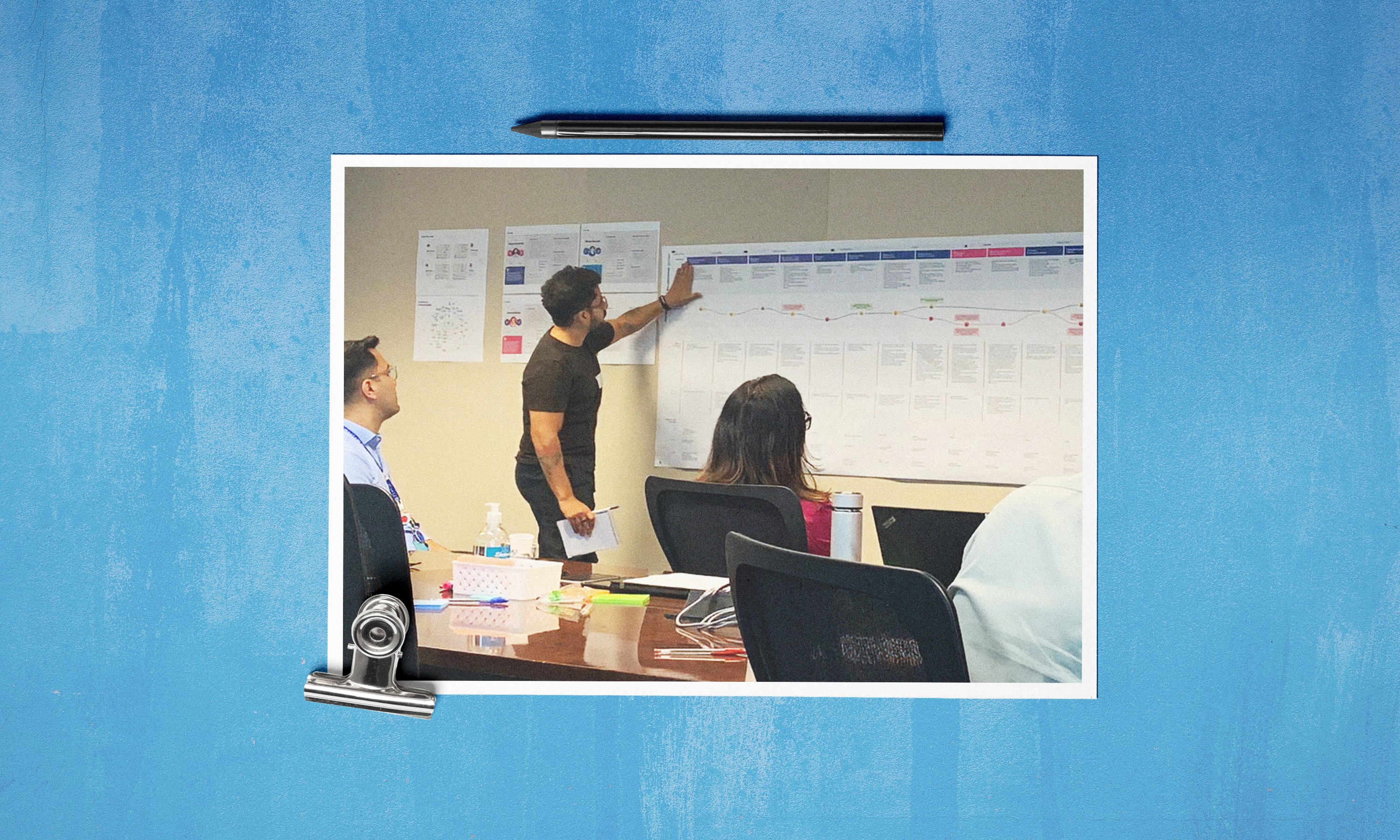
Evandro Siol presenting the broker's journey.
03
Definition & Ideation
Personas & Journeys: We mapped the Current Journey vs. Ideal Journey, highlighting that SMB brokers are multi-taskers who cannot tolerate "off-portal" manual processes.
Value Generation: We translated pain points into Value Drivers:
Autonomy: The ability to complete tasks and resolve issues without human intervention from the carrier.
Predictability: Standardized procedures that prevent rework and provide clear timelines.
Transparency: Active, real-time feedback on request status.
04
Delivery: Prototyping & Solution
Service Blueprint: This served as the central artifact, connecting frontstage broker actions to the necessary backstage automation in IT and Underwriting. It orchestrated how the portal should behave to support 65 identified improvement opportunities.
Service Prototyping: We validated five critical solutions using low-to-mid fidelity prototypes:
Digital Endorsement: A portal interface for real-time policy changes.
Instant Discount: A feature allowing brokers to negotiate prices and apply pre-approved discounts directly within the portal.
Commercial Bundles: Modularized products to facilitate cross-selling.
Claims Dashboard: A transparent tracking interface to reduce support calls.

Workshop on prioritizing solutions with stakeholders.
05
Outcomes & Lessons
Impact: The project resulted in a prioritized Implementation Roadmap across three experience levels: Basic, Differentiated, and Unique.
Operational Efficiency: Drastic reduction in manual tasks by digitizing underwriting rules.
Time-to-Market: Defined workflows allowing for quotes in just a few clicks.
Strategic Alignment: Consolidated Business Cases for each solution to facilitate investment approval by the executive board.
Reflection: The project reinforced that digital transformation in insurance relies on "letting go of control". A senior lesson was that service design must act as a mediator between technical risk security and the commercial need for speed. For future iterations, the focus would shift to real-time metric tracking after each roadmap release.

Current journey of a broker.