Client
Global Internal Plataform — Beverage company
Team
Evandro Siol
Focus
UI/UX Design
Time
1 month • 2024

01
Context & Challenge
The organization faced the challenge of evolving its existing employee platform, "Hub.net," into a more integrated, AI-centric ecosystem. The primary objective was to visually and functionally embed Soph.ia (a proprietary AI assistant) into the daily workflow without disrupting existing user habits. The goal was to transition from a static information repository to a personalized, "one-stop-shop" experience that catered to diverse workforce needs—from corporate managers to frontline industrial workers.
02
Discovery & Insights
A multi-layered research methodology was employed to validate design directions:
Benchmarking: Analysis of industry-leading tabbed navigation (YouTube, Medium) and modular layouts (Bento Grid designs).
Visual Perception Testing: Two cycles of qualitative testing with participants from various global regions (America, Africa, Asia and Europe).
Stakeholder Interviews: In-depth sessions with People Team members and managers to map technical and emotional requirements.
Findings & User Needs
Research revealed a significant tension between innovation and usability:
Hierarchy Displacement: Initial prototypes (Version 1) highlighted the AI so aggressively that essential tools (widgets) became inaccessible.
Information Density: Users felt the new layouts often pushed critical updates "below the fold," making navigation less efficient.
Language & Literacy: Frontline workers required mobile-first accessibility and voice-to-text features to bridge literacy gaps.
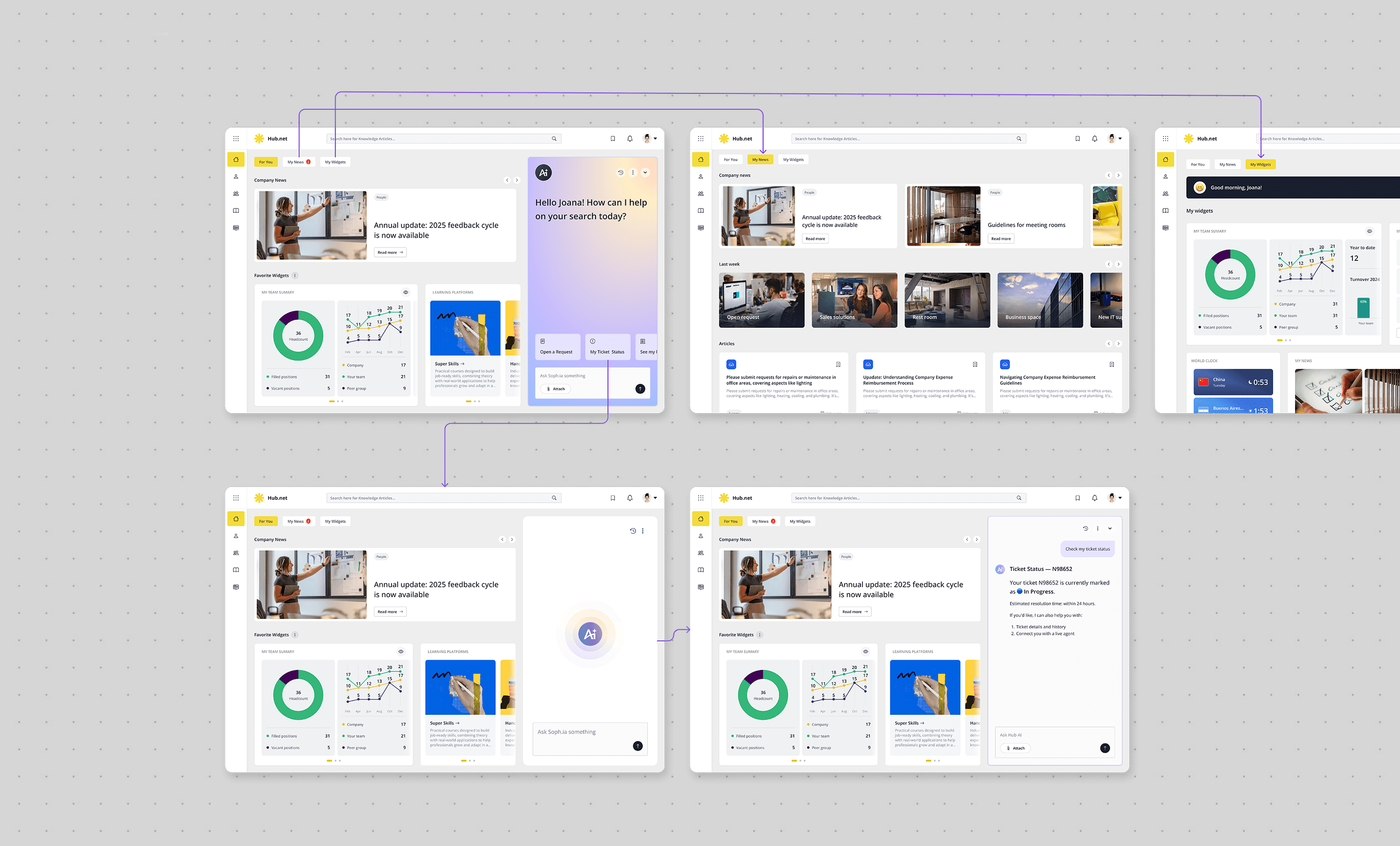
Simplified workflow for testing.
03
Definition & Ideation
New concepts from Home were tested (AI-first → balanced layouts)
Tested navigation models and content hierarchy
Iterated based on user feedback
Turning point:
Moving from an AI-centered design to a balanced ecosystem (AI + content + tools)
04
Delivery: Prototyping & Solution
The solution focused on designing a balanced and modular homepage that kept AI visible without making it the dominant element, while also restoring direct access to widgets and internal communications to maintain usability and information accessibility.
Strong preference for the balanced solution over AI-heavy versions
Improved usability and perceived value
Clear identification of AI trust as key adoption driver
Foundation for a broader service ecosystem
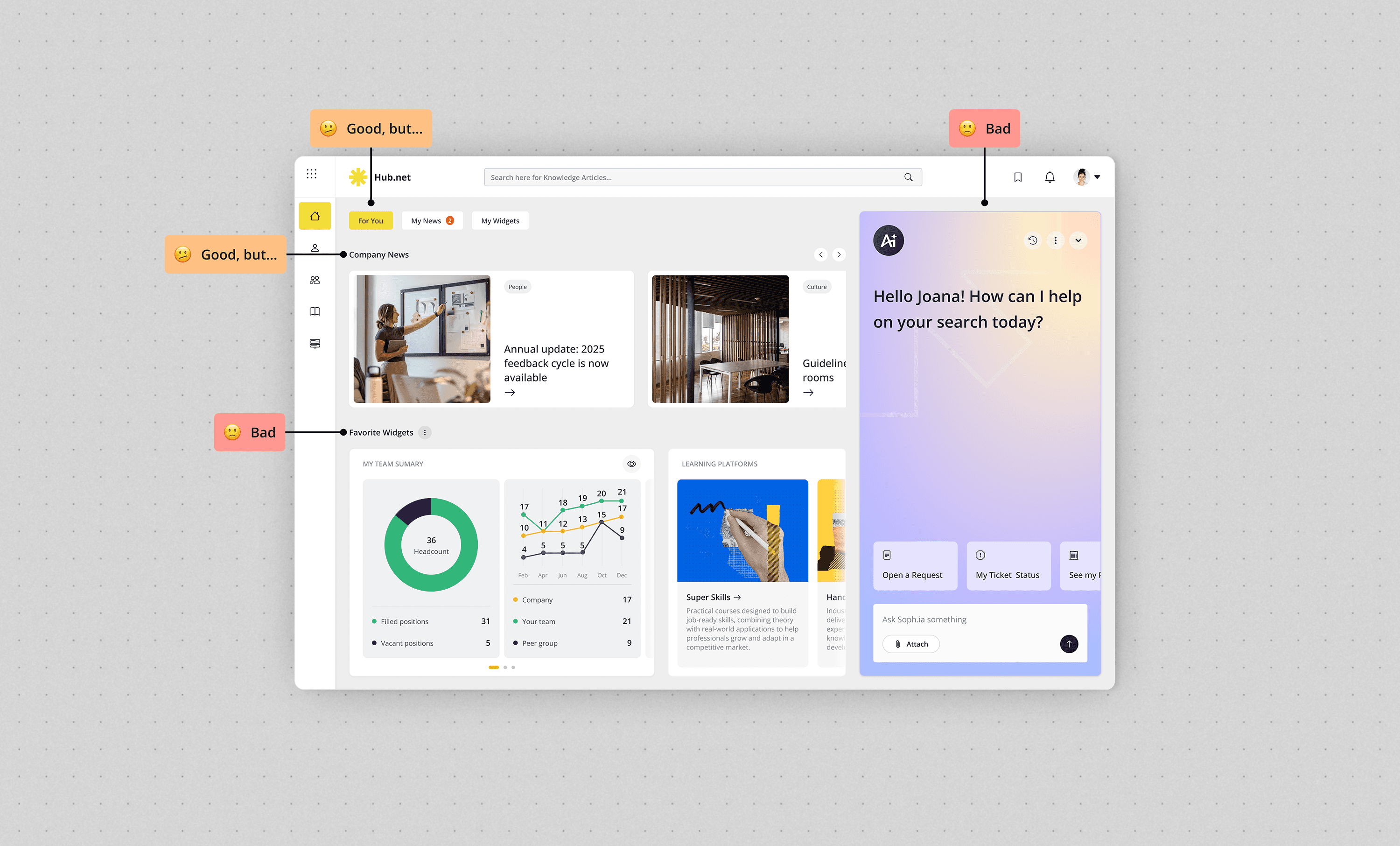
Version 3: Soph.ia is fixed on the screen.
05
Outcomes & Lessons
AI adoption fails if core experience is broken
Trust > visibility when introducing intelligent systems
Early validation of content hierarchy is critical
Service design must address functionality + perception
Next steps:
Improve AI performance and rebrand the assistant to overcome negative stigma and enable real adoption.
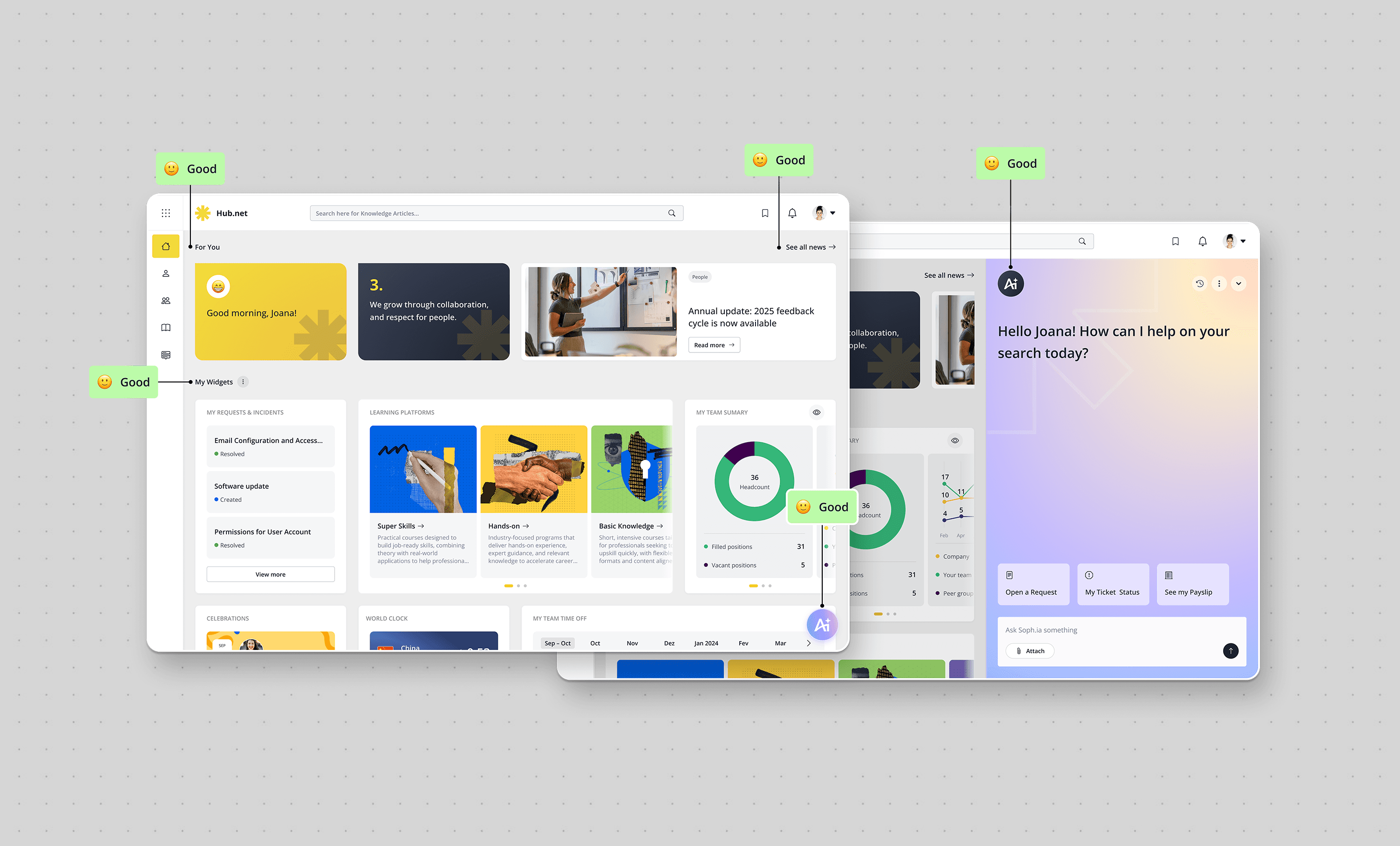
Final updated version: Sophia is now a floating button and the chat is expandable.